

Can you turn an idea into a high-performing short video in under five minutes?
You’ll see how fast content creation can change your workflow. Over 100,000 creators have used this toolset to make 1M+ short-form videos, and video now drives major web traffic and ROI.
The platform offers three simple pricing paths: monthly, annual (with 7 months free with annual plan), and a Business option for teams. Each tier maps to Starter, Creator, and Business features like AI script writing, voice cloning, captions, overlays, music, and platform-optimized formats for TikTok, Reels, and Shorts.
You’ll get three big wins for small businesses: speed to publish, the ability to scale across platforms, and a lower total cost than agencies while keeping consistent branding. Paid tiers include priority support with fast response times.
Key Takeaways
- You’ll compare monthly, annual, and team plans to match your U.S. small business goals.
- Short videos and templates cut production time to minutes so you can post more and win views.
- Plans include credits, premium outputs, and priority generation on paid tiers.
- Three small-business benefits: speed, scale, and lower cost than agencies.
- You’ll later learn how to claim discounts and where to check vendor site for refund details.
- Brief context vs. Veed.io and Descript helps you spot workflow differences.
What you’ll learn about Clipwise business pricing and savings
Learn how tier choice and annual payment affect your per-video cost and production rhythm.
You’ll see how monthly, annual, and team-level Business tiers differ and where yearly billing delivers the biggest savings. The annual option highlights 7 months free with annual plan, which lowers effective monthly spend when you plan a full year of output.
Outsourcing a single Reel can cost $150–$400, while a subscription reduces your per-asset cost when you batch work. Many creators cut a 3-hour edit down to under 5 minutes and produce 5–10 outputs per hour.
- You’ll learn which features are standard and which unlock at Creator and Business so you don’t overbuy.
- You’ll preview the coupon workflow at checkout to ensure your discount applies before you pay.
- You’ll know where to confirm the latest pricing and where to find the refund and billing policy on the vendor site.
- You’ll align plan selection with weekly posts to maximize value and avoid duplicate tools in your stack.
By the end, you’ll have a clear savings picture tied to expected monthly videos, the time reclaimed for strategy, and how steady posting builds cumulative views and helps you scale.
Understanding Clipwise for short-form video creation
Turn trend ideas into polished shorts quickly by automating the steps that usually slow you down.
Why creators and businesses use this approach to save time
Manual short-form editing often takes 2–4 hours for just 30 seconds of footage. You can cut that dramatically by automating scripting, captions, AI voice cloning, visuals, and formatting.
How the workflow speeds production
You replace long editing sessions with guided creation in minutes. The tool generates platform-ready outputs in 9:16 formats and applies pacing and cuts suited to each network.
You standardize your style and look with templates, overlays, and brand marks so every piece of content stays on brand.
- You automate the five biggest time drains—script, voiceover, captions, visuals, and formatting—so you publish faster.
- AI voice cloning plus 80+ languages lets you localize without re-recording.
- Auto-captioning boosts accessibility and watch time while keeping visual consistency.
- Platform presets remove manual formatting errors for TikTok, Reels, and Shorts.
For small businesses, this means less reliance on expensive editors, fewer production bottlenecks, and the ability to ride trends while momentum is high.
Clipwise pricing at a glance: monthly, annual, and business for teams
A. Compare starter, creator, and team rules to pick the plan that fits your monthly video goals.
Choose between Starter, Creator, and Business on monthly or annual billing. Annual plans include 7 months free with annual plan, which lowers your per-month cost when you commit for a year.
Monthly tiers overview
Starter covers light use up to 40 videos/month. Creator supports creators up to 200 videos/month and adds voice cloning. Business scales to 625 videos/month and adds priority generation and faster support.
Annual savings highlight
The annual option reduces effective spend. If you plan steady content creation, annual billing is the better ROI for ongoing production.
Business for teams
Business is for teams that need higher throughput, collaboration, and one-hour support SLAs. Premium rendering uses credits, so reserve it for high-impact clips.
| Tier | Monthly Limit | Key Add-ons | Billing |
|---|---|---|---|
| Starter | Up to 40 videos | Standard rendering, basic formats | Monthly or Annual (check vendor site) |
| Creator | Up to 200 videos | Voice cloning, more credits | Monthly or Annual (check vendor site) |
| Business | Up to 625 videos | Priority generation, one-hour support | Monthly or Annual (check vendor site) |
- Confirm included formats for TikTok, Reels, and Shorts before you commit.
- Start monthly to validate fit, then switch to annual for savings once your cadence is steady.
Monthly plans explained for U.S. small businesses
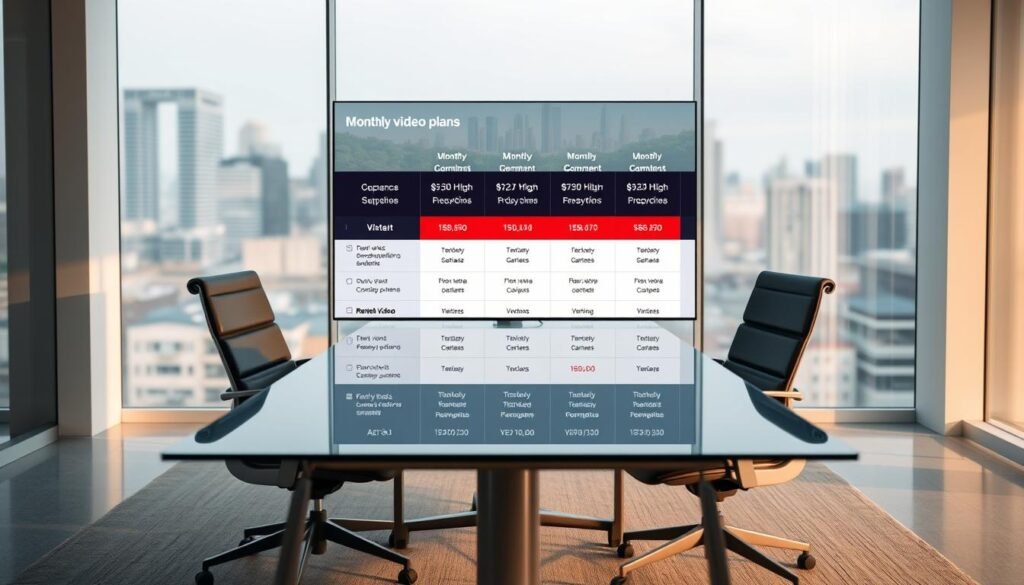
Monthly billing gives you predictable capacity while you test formats and refine a content rhythm. Pick a tier that matches your weekly publishing goals and team pace before moving to an annual plan.
Starter
Up to 40 videos/month with 1200 credits. Choose Starter if you’re testing workflows and need light output for basic campaigns.
Creator
Up to 200 videos/month with 2400 credits. This tier includes voice cloning and supports up to 80 premium and 120 standard outputs—good for creators who publish weekly.
Business
Up to 625 videos/month with larger premium capacity (up to 125 premium, 500 standard). Paid tiers include priority generation and one-hour priority support for pro teams.
- Plan credit use: premium uses 1 credit/sec; standard uses 0 credit/sec—reserve premium for hero launches.
- Confirm captions and core features so you publish accessible content consistently.
- Match the plan to your team’s pace to avoid hitting limits mid-campaign and document SLAs for support response time.
| Tier | Monthly Limit | Credits & Mix | Key Features |
|---|---|---|---|
| Starter | Up to 40 videos | 1200 credits (standard focus) | Basic generation, captions included |
| Creator | Up to 200 videos | 2400 credits; up to 80 premium / 120 standard | Voice cloning, higher throughput |
| Business | Up to 625 videos | Higher credits; up to 125 premium / 500 standard | Priority generation, 1-hour pro support |
Annual plans explained and who should choose them
Paying up front for a year shifts the cash flow conversation from month-to-month to ROI-driven planning. Annual billing applies the 7 months free with annual plan offer to reduce your effective monthly cost and smooth budget forecasting.
Before you commit, compare the upfront cost to expected returns from steady publishing. If you validated a weekly cadence and can batch work, the annual plan sharply lowers per-video cost versus outsourcing.
Outsourcing a single Reel can run $150–$400. When your team batches 5–10 videos per hour, you reclaim hours for strategy and community management.
Cash flow vs. ROI for annual commitments
- You’ll calculate effective monthly cost under the 7 months free offer to quantify savings.
- You’ll weigh upfront cash outlay against compounding views and steady content performance over 12 months.
- You’ll benchmark outsourcing rates to find the break-even point where annual subscription wins on cost.
- You’ll model seasonal spikes, upgrade paths, and verify promotions or coupons on the vendor checkout page.
- You’ll confirm contract and renewal terms on the vendor site before finalizing your decision.
Business for teams: collaboration, throughput, and support
When teams need steady weekly output, the Business tier is built to keep your calendar full and reliable.

Upgrade timing matters. Move up when weekly posts and client retainers push your need for sustained production past the Creator limits. Business supports up to 625 videos monthly and up to 125 premium outputs, so you avoid mid-month caps.
When to upgrade from Creator to Business
Consider upgrading when your calendar requires more than 200 monthly outputs. You’ll centralize work with shared templates and asset libraries so multiple creators can produce consistent content without redoing brand elements.
- Throughput: Use priority generation to stay out of queues during launches and busy windows.
- Support: One-hour pro support SLAs keep campaigns moving when issues arise.
- Workflow: Split premium vs. standard outputs—reserve premium for hero campaigns to manage credits efficiently.
- Team ops: Standardize review cycles so parallel publishing won’t create bottlenecks.
- Cost control: Recalculate cost per deliverable as posts scale to confirm Business becomes more economical than Creator.
For agencies or in-house teams, Business matches retainered client work and high-volume schedules. Monitor performance across teams and adjust capacity as your needs scale to preserve on-time delivery and consistent quality.
What’s included in each plan: features and credit usage
Know what you get and how credits affect your output. Each tier includes a mix of standard and premium rendering, plus tools for voice, visuals, and fast support. Use this to plan which assets deserve premium treatment.
Standard vs. premium videos and credits per second
Standard videos use 0 credit/sec and suit routine posts. Premium videos consume 1 credit/sec and are ideal for flagship launches or paid promos.
Voice cloning, AI hosts, overlays, captions, music
You’ll get voice cloning on Creator and Business plans. Diverse AI hosts and natural voiceovers cover 10+ languages so you can tailor tone and reach markets.
Add captions to boost accessibility and watch time. Use mood-based overlays and royalty-free music to shape emotion, cuts, and the overall look and style of your content.
Priority generation and support response time
Paid plans include priority generation to keep workflows moving during peak times. Creator and Business users also get one-hour priority support to fix blockers fast.
- Plan credit use: reserve premium (1 credit/sec) for hero assets.
- Use presets to export ready-to-post formats for TikTok, Reels, and Shorts.
- Document when to choose premium vs. standard to protect ROI and manage production calendars.
Three key benefits for small businesses
You can turn slow, manual editing workflows into a fast, repeatable content engine. Use automation to reclaim strategy hours and keep execution consistent.

Cut production time from hours to minutes
Many creators report shrinking a 3-hour edit to under 5 minutes. Automate scripting, voice, captions, and formatting so you spend less time on routine tasks.
That saved time lets you plan more ideas and test more hooks each week.
Scale content across TikTok, Reels, and Shorts
Platform presets handle ratios, pacing, and typography for each network. You publish more videos while keeping a unified style and look.
This approach helps you learn faster by testing angles and doubling down on winners.
Lower cost than agencies, with consistent branding
Insourcing repeatable short video work drops per-asset cost versus a $150–$400 outsourced Reel. You keep brand overlays, logos, and colorways intact as output rises.
Actionable step: Start monthly to confirm cadence, then move to annual billing once your content rhythm proves out to compress effective cost.
- Automate repetitive steps so your team focuses on community and strategy.
- Measure time and cost savings monthly to confirm ROI.
- Use Creator or Business tiers for voice cloning and premium rendering when needed.
Clipwise (duplicate check)
Start here to resolve naming confusion and anchor this guide to the correct business pricing details.
You’ll confirm that this article covers Clipwise (duplicate check) as a short-form video platform and not an unrelated tool. Use the exact phrase when searching so results map to the same product entity.
Key clarifications:
- You’ll verify plan names, limits, and included features against the vendor site before buying.
- Creator reviews are cited only to support time savings or improved quality for creators and teams.
- We avoid mixing in unrelated duplicate-detection software to keep focus on short-form video pricing and workflow.
Below is a compact comparison to help you spot if a search result is the correct product or an unrelated entry. Confirm final plan details on the vendor site before purchase decisions.
| Item | What to confirm | Why it matters |
|---|---|---|
| Product name | Clipwise (duplicate check) | Ensures you find accurate pricing and features |
| Plans | Starter, Creator, Business | Matches limits to your weekly videos and credit needs |
| Creator feedback | Time-savings & output quality | Validates ROI claims for short-form content |
How to choose the right plan based on output goals
Decide on a tier by mapping weekly output to monthly credit use and content goals. Start by listing how many short videos you plan each week and the average length of each clip. Multiply weekly minutes by four to estimate monthly minutes.
Estimate weekly short videos and credit needs
Standard outputs consume 0 credit/sec and suit routine posts. Premium uses 1 credit/sec for hero pieces.
Calculate monthly premium minutes and standard minutes separately. This tells you whether Starter, Creator, or Business fits your credit mix.
Match formats and language support to your audience
Pick formats for each network and plan localization if needed. Voice cloning and expanded premium capacity appear on Creator and Business plans. With 80+ languages, you can dub and caption to reach more viewers and boost views.
- Estimate weekly videos × average length → monthly minutes.
- Assign which ideas deserve premium treatment based on funnel stage and expected views.
- Confirm batching capacity—5–10 outputs per hour—so your team can hit deadlines.
- Choose Starter for light use, Creator for weekly multi-channel cadence, Business for daily, high-volume needs.
- Revisit capacity quarterly as your shorts and average length evolve.

| Need | When to choose | Key signal |
|---|---|---|
| Light, test runs | Starter | Under 40 videos/month; mostly standard |
| Weekly multi-channel | Creator | Up to 200 videos/month; voice cloning needed |
| Daily, multi-brand | Business | High throughput; priority generation and larger premium mix |
How to claim a Clipwise discount or coupon
Getting a promotional price is a quick process when you follow the right steps. Use a business email so account-level promos and invoices land correctly. The flow below walks you through account creation to your first content creation start while verifying the final cost.
Create an account on the vendor site
Sign up with your business email and complete profile setup. This unlocks the dashboard where promo fields and billing options appear.
Select monthly or annual billing
Choose monthly to test cadence, or pick annual to see the 7 months free with annual plan equivalent. Annual often shows bigger savings on the pricing screen.
Enter coupon code at checkout and verify discount
Click the checkout button, paste your coupon into the promo box, and watch the order total update. Always verify the discounted cost before you enter payment details.
Confirm plan, start generating your first videos
Review the order summary for videos/month and credits to ensure limits match your needs. Complete payment, open the workspace, and run a short test project to validate unlocked features like voice cloning or premium rendering.
- Upload brand assets and templates so new content publishes on-brand.
- Invite teammates if you bought a Business plan and assign roles for smooth collaboration.
- Document coupon terms and bookmark billing to manage upgrades or cancellations later.
Step-by-step: create your first video with Clipwise
Follow this clear creation flow to turn a single idea into a platform-ready short in minutes.
Input idea or link, choose format and language
Start by entering your idea or pasting a reference link. Pick the target format (TikTok, Reels, Shorts) and the audience language.
Review script and pick an AI host or voice clone
Generate a draft and then refine script sections for hook, body, and CTA until the messaging fits your brand.
Refine script again if pacing feels off. Select an AI host or enable voice cloning to keep a consistent voice across videos.
Add music, overlays, captions, then export
Choose royalty-free music to match mood and tighten pacing. Apply overlays and brand elements to maintain style and guide attention.
Add captions to boost retention and highlight key phrases for scannability. Preview the clip, tweak timing and transitions, and finalize in a few minutes.
- Export platform-ready files for TikTok, Reels, and Shorts.
- Duplicate the project to test alternate hooks and CTAs for faster iteration.
- Document what worked so your next creation is faster and more effective.
| Step | Action | Result |
|---|---|---|
| 1 | Input idea/link; set format & language | Draft tailored to platform |
| 2 | Refine script; pick AI host or voice cloning | Polished voiceover and timing |
| 3 | Add music, overlays, captions; export | Platform-ready clip in minutes |
Real-world time savings and results from creators
Speed matters. When creators cut editing time dramatically, output and results follow quickly.
From 3 hours to under 5 minutes per short is a consistent case study. One creator reduced a single Reel from three hours to five minutes and hit 100k views in a week after optimizing hooks, cuts, and format. Another producer made 12 Reels in one sprint, saved about 18 hours, and tracked $10k in direct revenue from lead gen and product links.
Batching is the multiplier: focused sprints that yield 5–10 videos per hour let you post more and test more trends without adding workdays.
“Turning a 3-hour edit into a 5-minute build changed our calendar. We posted daily, learned faster, and doubled weekly views.”
- You’ll see how minutes saved unlock more posts and creative experiments.
- You’ll learn that trend-aware scripting and tighter cuts raise completion rates and views.
- You’ll note that duplicating projects speeds iteration so you can try alternate hooks without extra hours.
- You’ll tie time saved to clear outcomes: leads, sales, and repeatable campaign wins.
Actionable takeaway: measure hours saved per campaign, then reallocate that time to strategy and community. That shift turns minutes saved into measurable business growth.
Cost comparison: Clipwise plans vs. outsourcing
Run the numbers: agency per-Reel fees versus subscription output shows where you win.
Agencies typically charge $150–$400 for a single short video. That adds up quickly when you need weekly posts or a full launch sequence.
With a subscription, you spread cost across many videos. Annual billing with the 7 months free incentive lowers your effective monthly rate and reduces per-video cost further.
Agency costs per Reel versus subscription ROI
Benchmark agency fees against your expected monthly volume to find the breakeven point.
- If one Reel costs $250, five outsourced videos equal $1,250 per month.
- Starter or Creator tiers often drop the per-video cost below agency rates once you produce multiple outputs.
- Annual billing compresses cost further; a launch burst of videos can make the subscription pay for itself fast.
| Scenario | Agency cost (avg) | Subscription effect |
|---|---|---|
| Low volume (10 videos/mo) | $1,500–$4,000 | Starter may match or beat agency on cost; verify credits/mix |
| Moderate volume (50 videos/mo) | $7,500–$20,000 | Creator or annual plan typically far cheaper per video |
| High volume (200+ videos/mo) | $30,000–$80,000 | Business tier offers best per-video economics and priority support |
Also factor time value: faster production accelerates testing and campaign iteration. That often improves CPC and CPA as you run more creative tests.
Action: calculate your monthly minutes, label which videos need premium rendering, and compare the per-video rate under Starter, Creator, and Business before you finalize budget. Confirm current pricing on the vendor site to finalize your plan choice.
Competitor comparison: where Clipwise stands out
When you evaluate options, match tool focus to your workflow so launches and daily posts stay on schedule.
Veed.io vs. Clipwise for short-form speed
Veed.io favors timeline-centric editing and fine-grain control. You get a familiar editor for manual cuts, transitions, and detailed color or audio tweaks.
By contrast, the automation-first platform emphasizes script-to-publish flows, AI hosts, voice cloning, captions, and platform-ready formats. That reduces manual editing steps and speeds up batch production.
Pick Veed.io if you need frame-level precision. Choose automation-first when your goal is high volumes and fewer clicks to post.
Descript vs. Clipwise for automated shorts workflow
Descript is audio-first: it excels at transcript-driven editing and rapid audio fixes. Creators who start with podcasts or long-form audio like this flow.
The automated short-form tool focuses on smart cuts, presets for TikTok/Reels/Shorts, overlays, and branding fidelity. You trade some timeline control for faster clip generation and A/B variant creation.
- You’ll compare timeline editing to automated short-form generation for speed and control.
- You’ll weigh audio-first workflows against script-to-video automation for different content types.
- You’ll assess formats presets, smart cuts, overlays, and style controls for consistent campaign identity.
- You’ll consider built-in voice cloning and AI hosts versus external plugins or manual processes.
- You’ll factor support SLAs and priority generation when launch timing matters to your team.
| Area | Timeline Editor (Veed.io) | Automation-First |
|---|---|---|
| Core strength | Frame-level editing and effects | Rapid script-to-clip generation |
| Best for | Precision edits and custom cuts | High-volume shorts and batch publishing |
| Unique value | Detailed timeline control | AI hosts, voice cloning, platform-ready formats |
Actionable review: map your weekly videos and decide whether automation or timeline control reduces context switching and boosts output per hour. Align the tool with your team’s preferred workflow to get faster results.
Refunds, billing, and policy notes
Clear billing rules help you avoid surprises and keep your content calendar steady. Before you subscribe, confirm refund and money-back policies on the vendor site so you know your options if plans don’t fit.
Refund / money-back policy: verify on vendor site
Policy details vary by vendor and region. The public FAQ may not list exact terms for refunds or money-back guarantees. You should open the vendor’s billing or refund page and read the current language before you commit.
If a refund policy is important to your purchase decision, collect a screenshot or save the policy link for your records. That helps when you need support or must document expense approvals.
How to unsubscribe or change plans
Manage billing from your account dashboard. There you can unsubscribe, upgrade, or downgrade plans without calling support in most cases.
- Time plan changes to avoid disrupting scheduled posts and planned campaigns.
- Confirm renewal dates and set calendar reminders to adjust capacity before billing cycles renew.
- Store invoices and receipts for cost attribution and tax records.
- Contact support for billing clarifications; paid tiers offer faster response times for urgent billing issues.
- Centralize subscription ownership to avoid multiple team subscriptions and to preserve content access when limits change.
| Action | Where to do it | Why it matters |
|---|---|---|
| Confirm refund policy | Vendor billing/refund page | Protects your cost and reduces risk |
| Unsubscribe / change plan | Account billing dashboard | Prevents service interruption of scheduled posts |
| Store invoices | Accounting folder / dashboard export | Enables cost tracking per channel and tax compliance |
| Contact support | Help center / priority channels | Resolve billing questions fast, especially on paid tiers |
Actionable step: verify refund wording, set renewal reminders, and assign one team owner for subscriptions so your videos and posts keep flowing on schedule.
Conclusion
This guide leaves you ready to turn ideas into consistent shorts and measurable views.
You’ve seen how Clipwise speeds creation so a single short video moves from idea to export in minutes. Use the Starter, Creator, or Business tier to match your weekly load and budget.
Plan premium versus standard videos, apply coupons at checkout, and batch production to scale output. As you publish more content, track views and iterate on trend hooks to grow reach.
Next step: visit the vendor site to confirm current pricing, pick a plan, and start your first project for a strong, actionable next step toward pro-level short-form production.